Showing posts with label essay format. Show all posts

Wednesday, 21 December 2016

How to cite Wikipedia in APA style

You can cite Wikipedia in APA style just like any other web page for which there is no author. For an article with no author, use the title of the article as the reference. In your reference section, give the full details of the citation beginning with the title. (The word used in the in-text reference must match the first word of the reference, which is in alphabetical order, so the reader can easily find the reference if desired).

Often teachers don't want you to use Wikipedia because it is publicly edited. That means right now I could go on it and add Bozo the Clown to the list of Presidents of the United States. But, Wikipedia has tools to deal with such malicious changes. First, authorized editors are notified automatically about changes, so they will quickly remove any deliberate damage. Second, they will ban me from further editing. So things are quickly returned to normal. Chances are that any citation from Wikipedia is correct.

However, for a research essay, you should be using peer-reviewed journal articles. This means that the information has been written and reviewed by experts in the field. Wikipedia is not a peer-reviewed source. So you probably shouldn't use it for a university-level paper. The point of a research paper is to do research. That means trying to find the original source of the information. Wikipedia is, at best, a secondary source. But it has its uses.

I often use Wikipedia to review the basic facts for some essay I am editing. When someone writes about the politics of Argentina and their grammar is so full of errors that I have difficulty understanding what they are saying, or even that there are two possible meanings, I might consult Wikipedia to get a basic understanding of the situation. In addition, Wikipedia can be useful for general definitions, just like you would use an encyclopedia or dictionary.

The APA style blog also warns against using Wikipedia. However, if you do use Wikipedia, they have a format. A recent client was writing about disaster planning and needed a basic definition of "social issues" to help her discuss the definition of "disaster." For the in-text citation, she put the title of the article and the date ("Social issue," n.d.). The title of the article is in quotation marks, and there is no specific date cited for the article. Notice that she uses the title of the article for both the in-text citation and for the reference list. This is because these two must be identical in all citations so the reader can easily find the reference in the reference list if they want to follow up on the citation.

Finally, here is her reference list citation:

Social issue. (n.d.) In Wikipedia. Retrieved (insert date here), from http://Wikipedia.com/wiki/Social_issue

Sunday, 20 December 2015

How to Write a Research Essay

In my editing work, I come across some wonderful essays that give me great hope for the next generation of scholars.

And then there are the others.

Don't despair. For many people, a few simple steps will get you on the road to writing research essays that will boost your grades and give you the skills you need to thrive in the modern economy.

In my opinion, research and writing are the most important skills that you gain from a university education. Being able to analyze an argument, find information, express opinions, make conclusions, and justify opinions are all vital in the wide variety of professions that require a post-secondary academic education. Writing a research essay, whether in first year courses or at the graduate level, contributes to developing these skills.

Before you start your research, have a pretty good idea of the topic you are going to write about. Research means looking for information, and you need to be specific. You may find that as you do research, you will see that your first ideas were not practical, or you might find something that is more interesting. It's usually OK to change at this point, unless you need permission from your instructor.

Research

The first step to writing a research essay is the research. Forget about Google. Your school should provide you with a login to access your university's database. In fact, there should be several databases, each of which is subject-specific. Choose the database appropriate to your area. If you are not sure, ask a librarian.

If you don't know how to access the school databases, you need to talk to the library staff. If it's Sunday night and your essay is due tomorrow, then say a prayer and use Google. However, what often happens is that Google will lead you to the names of the articles that you want to read, but they are in databases that you need to pay to access. Sometimes you can access whole articles through Google Scholar, but it's hit and miss.

Assuming you are on the library database, you are going to search for articles. Think of several key words that could be used to describe the topics you are interested in. You can search for these individually or separately. At this point in the research your goal is to identify several research studies that will give you information needed for your essay.

I like to combine specific words to get a smaller search result. However, being too specific might end up with no results. Don't expect to strike gold with the first search. This process can take a little while as you try as many combinations of search terms as you can think of. As you find articles, first look at the title, then check the abstract to see if they will be helpful. Only save the ones that show some promise.

Most of the time with a university database, you can save the article in pdf format. Sometimes the articles come with weird names like yscef2343.pdf. Save this with a name that makes sense to you. You are going to (hopefully) end up with a dozen or more articles (to be narrowed down later) so naming them sensibly saves you time later.

After you have a number of articles saved, your next step is to decide which ones are helpful. The normal structure for a research study is the introduction, methods, data, discussion and conclusion. The introduction will tell you the relevance of the study to existing theory. Usually it will identify gaps or contradictions that it is designed to address. That can be useful to provide you specific places to look for other studies in the area you are researching. I find that the methodology and data (especially for quantitative studies) are not useful at this point. I usually skip to the discussion to see what is of value of any particular study.

Writing

The important thing before you start writing is that you have the information you need available. This doesn't mean that you have a certain number of studies, but that you have reliable data to back up any statements you are going to make in your essay. No matter what claims you make, you will need to show that someone of authority believes the same thing.

First create an outline. An outline is simply a point-form map of your essay. First you will establish some basic facts (point 1, 2, 3). This might take two or ten paragraphs. Then you are going to make an argument about these facts, supporting some and contradicting others. This is true for virtually all subject areas.

Each paragraph will be structured like this:

  1. Topic sentence will begin the paragraph.
  2. Statement of fact with citation.
  3. Your discussion of this information (may go on for several sentences, or may introduce new information with citation).
  4. Apply this to a case at hand (if relevant).
  5. If additional information is related to this topic, include in the same paragraph.
All information needs to be cited. That's one of the places where people lose marks on research papers.

Be careful about quoting. APA style specifically says paraphrase unless a quote is so perfectly worded that you couldn't find better words. Don't quote statistics or findings, paraphrase. It's very poor style to insert a sentence quoting a statistic. Also make sure the quote really adds to the argument. I often see quotes that are inconsistent with the logic of the argument, or make some reference that is irrelevant.

After you've written all your paragraphs, you need to read it over and edit it several times to make it consistent and smoothly flowing. Write the introduction last, or at least be prepared to revise it after you write the body of the essay.

Get a friend to read it before you hand it in. There's nothing better than a second set of eyes to review what you've written to catch typographical and logical errors. If you don't have a friend who can do it, then consider hiring an editor. Look at the comments and edits to learn how you can write better the next time. Writing is a skill that takes time to learn, but if you've come this far, you can do it.

Monday, 10 August 2015

How to use transitional words effectively

Students are rightly taught that the use of transitional words and phrases will improve their writing. By and large, this is true. However, in my essay editing work I find that many people are not using transitional words and phrases correctly. Therefore, I am writing this blog post to help educate writers on how to use transitional words and phrases. This list is by no means exhaustive. Use the link at the bottom of the page to see more.

There are many different transitional words and phrases, and they should be used for different purposes. The key is to understand the logical connection between the phrases or sentences that these words link. "Transition" means "change" and there are many kinds of changes that can happen in an essay.

The first sense of change is to continue the present thought in a new sentence. We call these "additive" transitions. Additive transitions introduce an idea or example, continue a thought, show similarity, or provide reference or clarification. The following words are used as additive transition words:

  • moreover: Mountain climbing is physically challenging. Moreover, it is expensive and time-consuming.
  • indeed: Lamborghinis are expensive and rare cars. Indeed, I've never even ridden in one.
  • further: Michael Jackson was extremely popular in his day. Further, he sold millions of records.
  • furthermore: I will not tolerate disrespect from my students. Furthermore, lateness will be punished.
  • what is more: My education was very expensive. What is more, I had to borrow the money.
  • in addition: The prisoner was sentenced to 10 years for robbery. In addition, he received 5 years for escaping custody.
  • in fact: Donald Trump is very rich. In fact, his assets are estimated at between 3 and 10 billion dollars.

Another sense of change is to introduce an idea that is different from the previous idea. These are called "adversative" transition words. Use adversative transition words when the idea being introduced conflicts with ideas already introduced. This is useful in a persuasive essay, because you need to be providing a sense of two sides of an argument. Depending on how you handle the logic, these transition words can introduce an idea that supersedes the first idea or is negated by the first idea.


  • but: Smoking causes cancer, but many people continue to smoke.
  • still: Head injuries are very dangerous. Still helmets are not used in some sports.
  • however: Carbon dioxide is a proven greenhouse gas; however, many Americans remain in denial of climate change.
  • in contrast: Republicans deny climate change, in contrast to Democrats, who admit it.
  • while: Democrats are focused on income inequality, while Republicans are focused on conservative credentials.
  • whereas: The Senate voted to support the tax increase, whereas the House voted to repeal it.
  • on the other hand: Several major economists support the idea of universal daycare. On the other hand, the Treasury Department says it is unaffordable.

The fourth class of transition words are those that relate to cause and effect. These are called causal transitions. (Please watch out for the common transposition of letters that changes causal into casual; your spellchecker might even make the change for you.) I often see errors here when I edit student essays. You need to be very careful with your logic when using these transitions. Nonetheless, they are very important in laying out the logic for your essay. Notice that there are five different causal conditions: Cause, Condition, Effect/Result, Purpose, and Consequence.

1. When an assertion is followed by its reason

  • because: I am bringing my umbrella because it is raining.
  • due to: I am upset with my brother due to his lying to me.
  • inasmuch as: I am not going to vote for that politician inasmuch as he's a scoundrel.
2. When an action is conditional upon another event.
  • granted that: I will buy a car tomorrow, granted that I receive my bank loan.
  • even if: I will not purchase a Ford, even if the salesperson throws in a free oil change.
  • unless: I will marry that girl, unless I meet someone I like better.
3. When a cause is followed by its consequence.
  • as a result: I won a lottery, as a result I quit my job.
  • consequently: I closed my company, consequently I will no longer need your services.
  • hence: I took up skydiving, hence my life insurance rates went up.
4. When an action if followed by its motivation.
  • in order to: I started bodybuilding in order to impress women.
  • so as to: I enrolled in law school so as to become a lawyer.
  • so that: I bought a lot of books so that I could fill my bookshelf.
5. When a condition is followed by an outcome.
  • then: If my father gives me permission, then I will set sail tomorrow.
  • otherwise: If I am allowed to be an explorer I will first go to Antarctica, otherwise I will return to law school.
Other transition words are sequential. That is, they help us to keep track of arguments. The types are numerical, continuation, conclusion, digression, resumption, and summation.

1. To provide the first of a number of related items.
  • initially: The plan had several components. Initially, the army was to build a bridge.
  • first of all: First of all, the French Revolution was set in motion by a series of crop failures.
2. To relate items in a time sequence.
  • subsequently: Subsequently, the middle class lost faith in the leadership of the King.
  • previously: Voltaire had visited liberal philosophers in England.
  • eventually: Eventually, the revolution was followed by the Reign of Terror.
3. To provide the final item in a series.
  • finally: Finally, the British gave up their claim to the Thirteen Colonies.
  • in the end: In the end, the Constitution became the source of law.
  • to conclude: To conclude, Washington was elected President.
4. To provide a related point that is not directly part of the argument being developed.
  • incidentally: Incidentally, sans cullottes means "without britches", meaning the working men who did not wear the same type of pants as the elite.
  • by the way: By the way, the guillotine was not invented by Guillotine; it was merely advocated for by him as a less cruel means of execution.
5. To return to the main argument after a digression (as in 4).
  • to resume: To resume, the development of political parties had several consequences for France.
  • anyhow: Anyhow, the chaos of the Reign of Terror led the way to Napoleon's rise.
  • anyway: Anyway, the Constitution was never seen to be a perfect document, being amended several times in its early years.
6. To provide a summation of an argument.
  • to summarize: To summarize, there are many reasons for wearing a hat.
  • therefore: Therefore, the urban sombrero is destined to become a fashion staple.
  • in brief: In brief, nothing could demonstrate a man's savoir faire than a hat echoing multiculturalism.


The list of words for this blog post have been partially sourced from  https://www.msu.edu/~jdowell/135/transw.html, which is licensed for re-use through Creative Commons license 3.0 <http://creativecommons.org/licenses/by/3.0/>.

Tuesday, 14 October 2014

APA sample essay

If you are new to essay writing, this post is for you. APA style is simply a description of how to set up an essay and how to cite the sources you use for information. An APA essay is set up with 1 inch margins all around and double spaced lines. Here's a sample page of an APA essay.


There are a couple of things to notice. First, each page has a header with a running head on it. The running head is a short version of the paper title in all caps. The reason that you use a shortened version is that some titles might stretch over more than one line, and all you need to do is identify the title for each page. Second, you have a page number in the upper right corner. If you don't know how to set up a running head in MS Word, then read this blog post: How to format headers in APA style.

Notice that in addition to double spacing the lines, there is no extra space between paragraphs and each paragraph starts with an indent of 1/2 inch.

An APA essay also includes a cover page. Here's how to format an APA cover page.

That's all there is to setting up the format of the APA essay. The rest of the details on APA style have to do with how to make citations. Notice that in APA style the references are in the form (Last Name, year, page). That means after you refer to any information from another source, you include a reference to that source. Put the last name of the author(s), the year of the publication and the page number that the information can be found on. If there is more than one author, list up to 5 names. If there are more than 5 authors, list four followed by et al. Notice that "al." is an abbreviation, so requires a period. After the period, put a comma like this: (Francis, Smith, Jones, Brown, et al., 2014, p. 14).

Here's the thing that stymies many students writing an essay in APA style: how to cite a web page. I've done a whole blog post on this, but here's a brief summary. See if you can find an author. If you can name a person who wrote the post (for example in a newspaper article found on-line) then cite the name of the author as you would normally do. If the article is posted by an organization, and the purpose of the organization is related to the topic, then cite the organization. That might be true for citing the Alzheimer's Society, or the Centers for Disease Control (CDC, 2014). But if it's an organization that is organized for the purpose of sharing widely disparate information, then cite the title of the article in quotation marks. This would be the case for example if you cite an article from wikipedia ("Africa", 2014). Notice the dates are included. Many webpages have a date somewhere on the page. If there is not date, put "n.d." Each citation needs to match a citation in your References page. The citations are arranged in alphabetical order according the the name of the author (or organization, or article title). In the citation on the reference page, you would include the full URL so any reader can locate the article. Remember, the purpose of a citation is to let a reader verify any information you provide, so you need to provide clear directions of how to find the original source. Generally this means four pieces of information: Author, Date, Publication, and Publishing source.

And that's APA citation in a nutshell! For more information on specifics of APA citations, I like to refer to the Writing Lab at Purdue University. Also, APA has a blog on which it posts helpful information and answers questions.


Saturday, 11 October 2014

How to create a cover page in APA style

Creating an APA cover page is quite simple. It requires a minimum of information, but it shows your professor that you understand the basic details of APA style. An APA cover page has three basic features: a running head (with a shortened version of the essay's title), a page number, and a center section with the title of the essay, the name of the writer, the name of the course, the name of the professor, and the date, each on a separate line, double spaced.

Here's a simple graphic:

Notice that the running head begins with the words RUNNING HEAD in all caps. This is the only page on which the words RUNNING HEAD in all caps will appear. On all the rest of the pages only the actual running head (in normal upper and lower case) will appear. If you don't know how to insert a header, then read the blog post on how to create a header in APA style essays. Remember, you will format the header differently on all the other page, so you need to make sure that the document is formatted for different header on first page.


For the middle part of the cover page, simply enter the required information, set the paragraph setting to double space and the line format to centered.

After the date, place a page break. Use the page break function from the Insert menu. Don't just put a bunch of returns until the cursor moves down to the next page. That's sloppy and if you end up editing the cover page and there's a line added, then the extra line will move down and affect every page of your essay. If you don't know how to put in a page break, read my blog post 5 Essential MS Word Skills Every Student Should Know.

Wednesday, 8 October 2014

How to Format Essays in MLA Style

MLA style is used for essays written for English and the humanities. The key difference between MLA style and APA style is that APA uses the author-date form of in-text citation (also generically known as Harvard style) and MLA uses the author-page style of in-text citation. But there are several other details in the the way you format essays in MLA style that are important to note.

For both styles of essay, use double-spaced lines with 1 inch margins. Indent each paragraph 1/2 inch and do not put an extra line between paragraphs. So notice that this blog is not written in either MLA or APA style.

MLA style papers do not have a title page. Instead, on the first page of the paper, in the upper left hand corner, put your name, the course name, the name of the teacher, and the date on individual lines. Double space these lines. On the next line put the paper title centred in bold.

Both styles of essay require a running head (instructions from your teacher may vary--always follow the teacher's instructions). If you don't know how to insert a running head, check out this blog post on how to create a running head in MS Word. However, in MLA style, you do not put the title of the essay in the running head. A running head in MLA style only includes your last name (as the author of the paper) and a page number. These are aligned to the right. Use automated page numbers! Don't manually insert page numbers. When you are formatting the header, type your name, then space, then use the insert menu to insert a page number. The numbers will format automatically on each page.

As I stated before, the in-text citations are the key difference in MLA essays. Remember, the in-text citation is only a signpost for the reader to get more information about something you've said in your essay. You've quoted, paraphrased or otherwise referred to someone other work. The in-text citation provides sufficient information for the reader to go to your works cited page to find the full citation, which will tell them how to find the original work. This is true for both styles of citation. So you only need enough information to specific which item in your works cited list is the right one. It's pretty simple if you have only one work by a specific author. Simply put the name of the author followed by the page number in the work with no comma or punctuation between (author year). Notice that the period follows the parenthetical citation (it's like the citation is a little note to the reader contained within the sentence).

MLA style is more forgiving than APA style for sources such as webpages that do not have page numbers. Remember, the key is giving the reader enough information to find the full citation in the works cited page. Simply tell the reader the source in the text. "According to CNN.com..." Then the reader can skip to the Works Cited page and find the citation for CNN.com. If there is more than one citation for CNN.com, include some information about which article you are referring to.

If you don't know the author of a work you are citing, use a shortened version of the title. If the title is of a short work, place it in quotation marks; if the title is of a longer work, place it in italics.

Skipping down to the end of the paper, the reference section is titled "Works cited" in MLA essays. Center the title, put do not put it in bold. The entire works cited section should be double spaced with no additional spaces between entries. The paragraphs should be formatted as a hanging indent with 1/2 inch indent. If you don't know how to format a hanging indent, see this blog post on MS Word skills every student should know.

As of 2009, each entry needs to include the medium: book, print, web, film, etc.

Entries are listed alphabetically by author's last name and full first name (unlike APA style where entries only use the author's initials. The basic format is NAME, TITLE, PUBLISHING INFORMATION, DATE OF PUBLICATION, MEDIUM. In addition, if the medium is WEB, then the date of access follows the word WEB. (Note, I'm only using all caps to show which information is used; your paper would write these out using normal rules of capitalization).

My go-to source for formatting questions is the Writing Lab at Purdue University. Although I edit papers every day and I've come across most permutations at some point, I always go back there to verify what the correct format is.


Image courtesy of digitalart at FreeDigitalPhotos.net

Saturday, 20 September 2014

How to format headers in APA style essays

Many students find it difficult to format their APA essays with headers. Following these simple steps will solve this problem. In this post I will tell you how to insert running heads and page numbers in APA documents. These steps also work for heads in other style of essays, such as MLA, but the specific formatting may be slightly different.

Here's one of the most frustrating things about MicroSoft Word. The menu item used to insert a header is under the VIEW menu. Even after years of editing essays, I almost always look for it under the INSERT menu because I'm thinking to myself "I need to insert a running head." Ironically, after the header is created, you merely need to double click on it to edit it, so you don't need to go back to the VIEW menu to edit the header.

Notice that this is called "Header and Footer." The header and footer editing screens are always active at the same time, but you don't need to use footers in APA essays. They are used for other types of documents.

Once you have the header editing screen active, you need to type in the header info. Notice that APA requires the first page (the cover page) to have the header begin with the following phrase in capital letters: RUNNING HEAD. I don't know if they think anyone reading a university level essay might be stupid enough to not know why there is a title above every page of the essay, or if they just want to justify the use of the caps lock key every time someone writes an essay, but I think this looks ugly. I would dispense with this if it were up to me.

The other thing to notice is that the running head is not necessarily the same wording as the title. The running head should be short enough to fit on one line (leaving room for the page number) along with the words RUNNING HEAD. Let's say your essay title is "Sylvia Plath and the tortured genius: modern feminism and the struggle for autonomy in artistic creation." (Apologies to Sylvia Plath scholars, feminists, and artists.) That's way too long to fit on one line at the top of every page. So the running head would look like this: "RUNNING HEAD: Sylvia Plath and artistic creation."

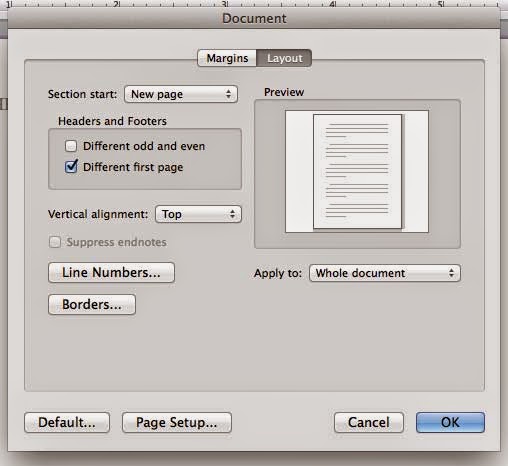
Only the cover page needs the caps lock RUNNING HEAD. All the other pages in the essay will have the short version of the title (but now it's in ALL CAPS). So you are going to have to insert the header one more time, but before you do that, you need to make sure one thing is set in the document. The formatting of the document needs to be set to have a different first page (the cover page). To do this, access the DOCUMENT formatting window. It's pretty simple. Under the FORMAT menu, select DOCUMENT, and the DOCUMENT window will open. Click on LAYOUT and the the check box on "Different first page." Now the second page in the document will have no header, so you can go to the second page, use the VIEW menu to view the editing screen for the header and footer, and then type in the running head in all caps.


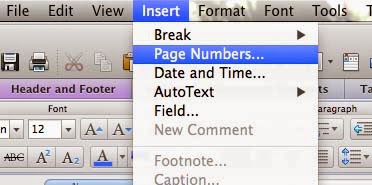
But now you need to also insert the page numbers. The headers are conveniently set up with pre-set tabs. As an aside, you should never move characters over by using a bunch of spaces. If you hit repeated spaces to move the page numbers to the right, then the location of the page numbers will be inconsistent depending on the computer of the person viewing the document. In some cases, the page numbers might even jump to a second line on the left. Always use the tab key (on the left side of the keyboard, just above the caps lock key) to move things. And take the time to learn how to set tabs. Depending on how long your running head is, when you hit the tab key, the cursor will jump to the middle of the page, or to the right hand side. If it goes to the middle, then do another tab to get the cursor to the right. Under the INSERT menu, choose PAGE NUMBERS to call up the page number dialogue box. Make sure you have alignment right and show on first page checked, and click OK. You can change the format to Roman numerals, etc, but probably the default is correct. If you have multiple sections on a thesis, then you need to use different formats and start the regular numbers on the first page of the actual content. Now, all you have to do is click the "Close" box on the little line under the header, and every page in your document will be properly formatted with APA headers.

Tuesday, 26 November 2013

How to cite a webpage in APA style

There seems to be some controversy over how to cite a web page using APA style. When a student finds information on a website, he or she often uses the title of the article as the reference. For example, citing this page he or she would use ("How to cite a web page", 2013). This is wrong, because there is clearly an author for this blog post: Peter J. Francis. You should cite the name of the author, just like you would a journal article. Be thorough; look carefully in the fine print for an author.

Just today I edited an essay that cited three newspapers. I know that virtually every story in a newspaper has a byline. I used to write for newspapers and seeing my name in print was half the reward. There is absolutely no reason not to know the name of the author of a newspaper article. Normally, when I am editing, I correct these things, but this person had not provided the full url in the reference section (which I pointed out when I returned the paper).

However, often a webpage is written by the member of a staff of an organization. Let's say HyperGraphix was a big anonymous editing company and there was no author on the page. Would you cite it as ("How to cite a webpage in APA style", 2013) or (HyperGraphix, 2013)?

I've researched this a lot and the answer is contradictory. Sometimes you use the name of the organization, sometimes you use the title of the article. I will try to tease out what the difference is.

There are four elements necessary for a complete citation: author, date, title, and url. Format is added if the format is out of the ordinary, such as a blog post, or lecture notes. One or more of these may be missing. This link tells you to use the title when you have no author.
http://blog.apastyle.org/files/how-to-cite-something-you-found-on-a-website-in-apa-style---table-1.pdf

However, this link says to use the organization as author when you have no author named. http://www.apastyle.org/learn/faqs/web-page-no-author.aspx

Normally I use the OWL (Purdue University Online Writing Lab) as my goto source for APA references. https://owl.english.purdue.edu/owl/resource/560/01/ This easy to use resource has lots of examples for all APA questions. There is also an MLA section, and I recently discovered a Chicago section. Many universities have APA or other style references, but I find this one to be the most comprehensive. But the OWL is strangely silent on the web page with no author. Maybe they don't give a hoot!

The two links above are both from the APA, so which is right? I had a client marked down because she used a title where an organization should have been used. I think the question is whether the organization is a professional organization, or is it just a place that posts information. For example, my client was doing a Master's degree in Nursing and was citing a document from the Centers for Disease Control. So this is a document that has been prepared for and by an organziation (CDC, 2013). Cite the organization.

On the other hand, if you were citing Travelocity's tips for vaccination, then Travelocity is merely posting information it has obtained elsewhere. Cite the webpage title ("Get stuck for health", 2013). Notice the webpage title used double quotation marks. You can use an abbreviated version of the title.

This makes some kind of sense because you can trust a named author more than an organization and an organization more than some webpage. There's a hierarchy of trust.

Back to my original question. Would you cite it as ("How to cite a webpage in APA style", 2013) or (HyperGraphix, 2013)? I would like to think you would use the latter. HyperGraphix is my editing business, and I should have some expertise. In addition, this website is the sole property of my editing business, and it's not designed to let other people post. You can be certain that HyperGraphix is responsible for the content. So give me the credibility of using my business name.

The next problem is how to set up the reference in the reference section. Do not use quotation marks on the title in the reference section. The first part of the entry should be the same as the in-text reference. As I explain to my students, the system is designed so you give a brief in-text reference, and if the reader wants more information, he or she should be able to find the full information in the reference section. That's why the reference section is in alphabetical order, and each entry begins with the same words used in the citation.So for the reference entry to this web page, write it like this:

Francis, P.J. (2013). How to cite a webpage in APA style.  [weblog]. Retrieved from http://essaywritngtips.blogspot.ca/2013/11/how-to-cite-webpage-in-apa-style.html

If there was no author, then it would be:

How to cite a webpage in APA style. (2013). [weblog]. Retrieved from http://essaywritngtips.blogspot.ca/2013/11/how-to-cite-webpage-in-apa-style.html
Updated April 2, 2014.

Wednesday, 16 May 2012

How to Use MLA Style in Writing Essays

This is only a brief overview of some of the issues of using MLA style in your text references based on some of the problems I've seen in the essays I've edited. If you want to source the details of MLA style, go to the source: The Modern Languages Association.
One major difference between referencing styles is how to format in-text citations. This means that the name of the author and the page the reference is from are inserted in brackets directly after the reference (Francis 56). Note that in MLA style, you are citing the page for paraphrases as well as the author's name, but not the date.
If there are multiple editions of the work, then you need to let your readers be able to locate the cited passage in their own edition. Help them out by including a reference to which volume (vol.), book (bk.), part (par.), chapter (ch.), section (sec.), or paragraph (par.) you are citing from. For example: (Plato 34; bk. 5).
If you cite more than one author with the same last name, use the first initial as well, in your in-text citations. (P. Francis 34)
With multiple authors, cite all names for three or fewer; use et al. for four or more. Write out "and" before the last name. Do not use an ampersand: &.
If the same author has multiple works cited, then include a shortened title of the work as well. (Francis, "Justin Bieber's love child" 56). Note, we use a comma after the author's name here. It's preferable to keep the citation smaller by including some of the information in the text, so the reader has a clue as to what work you are discussing. "In his memoir about growing up as Justin Bieber's love child, Francis confesses to space time anomalies that made him decades older than his father" (45).
If you don't know the author's name, then use the title of the work. The key is to use what ever is going to be the first part of the citation in the Works Cited page. When you are using the title of the work, enclose it in quotation marks ("How to make citations" 44).

Citing Sources from the internet in MLA style

Umm...don't. No seriously. Be careful. If you are using your school library to access on-line versions of print sources, treat them as print sources, citing date of publication, etc. But for web pages, first evaluate if it is a reliable source. Many teachers will not accept Wikipedia as a reliable source. If you writing on Wordsworth and you are citing the website of the Wordsworth Scholars' Association, then OK. But be cautious. Nonetheless, there is a citation style for you.
Since page numbers don't matter on the internet, forget them. In your in-text citation, use the first words you will use to reference the web page in your Works Cited page. This will be either the name of the author, the title of the webpage, or the domain name. Do not include the http:// and all the junk after the domain name. (How to use APA Style)
The first challenge for using APA style for in-text citations is when to use page numbers. "If you are quoting from a text, then you should use page numbers." (Francis, 2010, p 3.) If you are only paraphrasing an idea, then only use the author's name and date of publication. (Francis, 2010) If a work has two authors use both name joined by "and" in the text and both names joined by & in the parentheses (Francis & Francis, 2010). With three to five authors, cite all names in the first instance and use "et al." in subsequent instances. Six or more, simply use et al. For an unknown author, cite the name of the work (HGPublishing, 2010).
It is important to note that et al. is an abbreviation and ends in period. Do not put a period after a comma.

Reference page in MLA Style

At the end of your essay, you need a Works Cited page. This is a list of all the references you have used, in alphabetical order by last name of the main author. The Works Cited page should be a separate page from the body of the essay. Double space all citations, but do not put an extra space between citations. Use a hanging indent format.
As of 2009, MLA style requires you to state the type of resource such as print, web, CD, etc. You do not have to cite URLs. Sometimes instructors will insist on URLs, so include them in angle brackets followed by a period. Include a database name if you have retrieved an previously published article from an on-line database.
Capitalize each word in a title, except prepositions and conjunctions. (Basically the main words, and always the first word.)
Order the entries alphabetically by author's last name. If you are citing more than one work by the same author, order them alphabetically by work title. Only write out the author's name for the first entry. In subsequent entries, substitute three hyphens followed by a period (---.) for the author's name.
Where a work has no known author, place it alphabetically according to title.

Format for books

Last name, First name. Title of Book. Place of Publication: Publisher, year of publication. Medium of Publication.
Notice that the Title of the Book is in italics. The medium of publication would be "Print" for a book.
When a work is part of an anthology or collection, then cite the author of the key part first, followed by the title of the key part, then the main collection.
Last name, First name. "Title of Essay." Title of Collection. Ed: Editor's name(s). Place of Publication: Publisher, year of publication. Page range. Medium of Publication.
Notice that the title of the collection, the main title of the book, is in italics. Also notice the addition of the page range. This is because you are not citing the whole book. The page range should be cited as simply as possible. (33-78).
If you are citing several works from the same anthology, place one entry for the anthology alone such as:
Last name, First name. Title of Collection. Ed: Editor's name(s). Place of Publication: Publisher, year of publication. Medium of Publication.
Then an entry for each part of the collection you used:
Last name, First name. "Title of Essay." Editor's name(s) Page range.

Format for periodicals

The basic format of bibliographical references for journal articles is:
Author(s). "Article Name." Journal Name. Day month year: pages. Medium of publication.
Note the use of italics above. Only the name of the publication is in italics.

Format for internet sources

Like any other source, the key is that your reader can locate the document you are citing. Therefore the key information to include includes: author name, article name in quotation marks; title of website, project or book in italics; version numbers, dates or posting references; publisher information; page numbers (if available); date you accessed the information; medium of publication; and include URL only if specifically requested.
For an entire website:
Editor, author, or compiler name (if available). Name of site. Version number. Name of institution, sponsor or publisher (if available). Date of resource creation (if available). Medium of publication. Date of access.
Sometimes you have to dig for this information. Sometimes even when you dig, it's not available.
Here's the reference for this site:
Francis, P. HGPublishing.com. HyperGraphix Publishing Services. n.d. Website. Date of access.
Here's the reference for this page:
Francis, P. "How to Use MLA Style." HGPublishing.com. HyperGraphix Publishing Services. n.d. Website. Date of Access.

How to use APA Style

This is only a brief overview of some of the issues of using APA style in your text references based on some of the problems I've seen in the essays I've edited. If you want to source the details of APA style, go to the source: The American Psychological Association.

In-text citations 

Basically, the difference between APA style and the other major style of citations, MLA, is how APA uses in-line text citations. In APA style, the name of the author and the year of publication are inserted in brackets directly after the reference (Francis, 2010).

The first challenge for using APA style for in-text citations is when to use page numbers. "If you are quoting from a text, then you should use page numbers" (Francis, 2010, p 3.). If you are only paraphrasing an idea, then only use the author's name and date of publication (Francis, 2010). If a work has two authors use both names joined by "and" in the text and both names joined by & in the parentheses (Francis & Francis, 2010). With three to five authors, cite all names in the first instance and use "et al." in subsequent instances. Six or more, simply use et al. For an unknown author, cite the name of the work (HGPublishing, 2010).

It is important to note that et al. is an abbreviation and ends in a period. Do not put a period after a comma. If you have two sources for the same information, cite both in the same order as in the bibliography. (Francis, 2010; HGPublishing, 2001)

References

At the end of your essay, write a list of references. This is a list of all the references you have used, in alphabetical order by the last name of the main author. If there is not author's name available, use the title of the article, but place it alphabetically in the list as if it were the author's name. The reference list should be a separate page.

The basic format of bibliographical references for journal articles is:
Name, Initial., Name2, Initial., and Name3, Initial. (Year) Article Name. Journal Name. Volume number(issue number), pages.

Note the use of italics above. Only the Journal Name and Volume number are in italics. Each name is identified by the last name followed by the intial(s). Even if the journal identifies the authors by first name and middle name, you only use initials in APA style.

The biggest controversy I hear from students is how to cite sources from the internet. I often see students who include the date and URL for every reference which they downloaded. What the APA says is this:
"When a citation includes a digital object identifier (DOI) no further information is needed. When a DOI is not available, and a URL is included, do not include retrieval dates unless the source changes over time." A DOI is a special number used to identify an electronically published article. It is usually found on the first page of the article near the copyright notice or on the landing page where the article was found.

This means you do not need dates when you download articles from your library's electronic journal database. Simply use the DOI. You only need dates and URLs when you download information from a wiki since that web page can change at any time. For a web page, try to see if there is a date (often in small print for copyright purposes at the foot of the page). If there is a date, use it in brackets after the title. If there is no date use "n.d." for "no date." The reference for this page would be:
HyperGraphix Publishing Services (n.d.) How to Use AP Style. Retrieved from http://essaywritngtips.blogspot.ca/2012/05/how-to-use-apa-style.html