Showing posts with label APA. Show all posts

Wednesday, 21 December 2016

How to cite Wikipedia in APA style

You can cite Wikipedia in APA style just like any other web page for which there is no author. For an article with no author, use the title of the article as the reference. In your reference section, give the full details of the citation beginning with the title. (The word used in the in-text reference must match the first word of the reference, which is in alphabetical order, so the reader can easily find the reference if desired).

Often teachers don't want you to use Wikipedia because it is publicly edited. That means right now I could go on it and add Bozo the Clown to the list of Presidents of the United States. But, Wikipedia has tools to deal with such malicious changes. First, authorized editors are notified automatically about changes, so they will quickly remove any deliberate damage. Second, they will ban me from further editing. So things are quickly returned to normal. Chances are that any citation from Wikipedia is correct.

However, for a research essay, you should be using peer-reviewed journal articles. This means that the information has been written and reviewed by experts in the field. Wikipedia is not a peer-reviewed source. So you probably shouldn't use it for a university-level paper. The point of a research paper is to do research. That means trying to find the original source of the information. Wikipedia is, at best, a secondary source. But it has its uses.

I often use Wikipedia to review the basic facts for some essay I am editing. When someone writes about the politics of Argentina and their grammar is so full of errors that I have difficulty understanding what they are saying, or even that there are two possible meanings, I might consult Wikipedia to get a basic understanding of the situation. In addition, Wikipedia can be useful for general definitions, just like you would use an encyclopedia or dictionary.

The APA style blog also warns against using Wikipedia. However, if you do use Wikipedia, they have a format. A recent client was writing about disaster planning and needed a basic definition of "social issues" to help her discuss the definition of "disaster." For the in-text citation, she put the title of the article and the date ("Social issue," n.d.). The title of the article is in quotation marks, and there is no specific date cited for the article. Notice that she uses the title of the article for both the in-text citation and for the reference list. This is because these two must be identical in all citations so the reader can easily find the reference in the reference list if they want to follow up on the citation.

Finally, here is her reference list citation:

Social issue. (n.d.) In Wikipedia. Retrieved (insert date here), from http://Wikipedia.com/wiki/Social_issue

Saturday, 5 November 2016

Don't put a quote in your essay!

Many of the essays that I edit use quotations from sources. That's fine. But don't call it a quote. It's a statement if you need to name it at all. (Usually, you don't.)

The Merriam-Webster dictionary provides three definitions for quote. All are verbs. To quote is an action. You are actively encouraged to quote, but don't call it a quote. It's a quotation.

But wait! There's more

I'm not writing this to be pedantic about the difference between a noun (quotation) and a verb (quote.) The point is that you don't need to name your citation as a quotation.

A quotation is what you call the words of another that you put in your essay and surround with quotation marks. It's merely a statement. (And even that is too wordy.)

Here's what I typically see in a first-year essay:


  • In the quotation by XXX, ...


Or worse:


  • XXX quoted, "...."


Neither of these should use the word "quoted" or "quotation."

Instead of "quoted," you can simply say "said." Or use the old standby, "according to" followed by the name then a comma and then the quotation itself.


  • According to Shakespeare, "Life is but a stage..."
Here's the worst way to quote in an essay:
  • In a research study by Smith and Smith on essay writing,  it says "Essay writing is hard."
If you are worried about your word count, then this could be the way to go, but for whatever marks you save by being long enough, you will lose marks for poor writing. We already know it was a research study, that's why it has been published. Naming anything and then using "it" can't be good. How about the following?
  • According to Smith and Smith, "Essay writing is hard."
We've turned 17 words into 9. That's almost a 50% savings. And who wouldn't like 50% off? I'm sure the person who marks your essay would really enjoy this.


When do you say quotation?

In the rare cases when you would use the word quotation, it would be if you need to be explicit about someone using someone else's words.


  • A poster with a quotation from Plato graced the classroom.


  • Smith's quotation of Descartes' statement, "I think, therefore I am," was illogical and inappropriate.


Sunday, 20 December 2015

How to Write a Research Essay

In my editing work, I come across some wonderful essays that give me great hope for the next generation of scholars.

And then there are the others.

Don't despair. For many people, a few simple steps will get you on the road to writing research essays that will boost your grades and give you the skills you need to thrive in the modern economy.

In my opinion, research and writing are the most important skills that you gain from a university education. Being able to analyze an argument, find information, express opinions, make conclusions, and justify opinions are all vital in the wide variety of professions that require a post-secondary academic education. Writing a research essay, whether in first year courses or at the graduate level, contributes to developing these skills.

Before you start your research, have a pretty good idea of the topic you are going to write about. Research means looking for information, and you need to be specific. You may find that as you do research, you will see that your first ideas were not practical, or you might find something that is more interesting. It's usually OK to change at this point, unless you need permission from your instructor.

Research

The first step to writing a research essay is the research. Forget about Google. Your school should provide you with a login to access your university's database. In fact, there should be several databases, each of which is subject-specific. Choose the database appropriate to your area. If you are not sure, ask a librarian.

If you don't know how to access the school databases, you need to talk to the library staff. If it's Sunday night and your essay is due tomorrow, then say a prayer and use Google. However, what often happens is that Google will lead you to the names of the articles that you want to read, but they are in databases that you need to pay to access. Sometimes you can access whole articles through Google Scholar, but it's hit and miss.

Assuming you are on the library database, you are going to search for articles. Think of several key words that could be used to describe the topics you are interested in. You can search for these individually or separately. At this point in the research your goal is to identify several research studies that will give you information needed for your essay.

I like to combine specific words to get a smaller search result. However, being too specific might end up with no results. Don't expect to strike gold with the first search. This process can take a little while as you try as many combinations of search terms as you can think of. As you find articles, first look at the title, then check the abstract to see if they will be helpful. Only save the ones that show some promise.

Most of the time with a university database, you can save the article in pdf format. Sometimes the articles come with weird names like yscef2343.pdf. Save this with a name that makes sense to you. You are going to (hopefully) end up with a dozen or more articles (to be narrowed down later) so naming them sensibly saves you time later.

After you have a number of articles saved, your next step is to decide which ones are helpful. The normal structure for a research study is the introduction, methods, data, discussion and conclusion. The introduction will tell you the relevance of the study to existing theory. Usually it will identify gaps or contradictions that it is designed to address. That can be useful to provide you specific places to look for other studies in the area you are researching. I find that the methodology and data (especially for quantitative studies) are not useful at this point. I usually skip to the discussion to see what is of value of any particular study.

Writing

The important thing before you start writing is that you have the information you need available. This doesn't mean that you have a certain number of studies, but that you have reliable data to back up any statements you are going to make in your essay. No matter what claims you make, you will need to show that someone of authority believes the same thing.

First create an outline. An outline is simply a point-form map of your essay. First you will establish some basic facts (point 1, 2, 3). This might take two or ten paragraphs. Then you are going to make an argument about these facts, supporting some and contradicting others. This is true for virtually all subject areas.

Each paragraph will be structured like this:

  1. Topic sentence will begin the paragraph.
  2. Statement of fact with citation.
  3. Your discussion of this information (may go on for several sentences, or may introduce new information with citation).
  4. Apply this to a case at hand (if relevant).
  5. If additional information is related to this topic, include in the same paragraph.
All information needs to be cited. That's one of the places where people lose marks on research papers.

Be careful about quoting. APA style specifically says paraphrase unless a quote is so perfectly worded that you couldn't find better words. Don't quote statistics or findings, paraphrase. It's very poor style to insert a sentence quoting a statistic. Also make sure the quote really adds to the argument. I often see quotes that are inconsistent with the logic of the argument, or make some reference that is irrelevant.

After you've written all your paragraphs, you need to read it over and edit it several times to make it consistent and smoothly flowing. Write the introduction last, or at least be prepared to revise it after you write the body of the essay.

Get a friend to read it before you hand it in. There's nothing better than a second set of eyes to review what you've written to catch typographical and logical errors. If you don't have a friend who can do it, then consider hiring an editor. Look at the comments and edits to learn how you can write better the next time. Writing is a skill that takes time to learn, but if you've come this far, you can do it.

Saturday, 17 October 2015

How to use APA references: Just the basics

We edit psychology papers

In every new school year, another crop of scholars is faced with the perennial issue of using citations in their writing. Many people engage me to edit psychology papers. Of course, psychology is the main discipline to use APA, but many professors assign APA style as the reference style for papers in a wide variety of disciplines. Here are a few tips to make it easier. I'm keeping it short and sweet with just the basics here, so if you have more questions, check out some of my other posts under APA Style, or visit the OWL, which is a great source for writing advice in APA, MLA or Chicago style.

Use parentheses correctly

The first thing you need to know is how to use parentheses. When you put something in parentheses it adds to the sentence, but the sentence must be able to stand alone without it. When you use APA, you are told to enclose the author's name and year of publication in parentheses (Francis, 2015). Notice that the sentence above reads perfectly well without the part in parentheses. However, there are two ways to make a citation. Sometimes you introduce the author's name with a signal phrase at the beginning of the sentence. In this case, you only put the year in parentheses.

According to Francis (2015), blah blah blah.

What I see with some new writers is that they have got stuck on the idea that the author's name is always in parentheses, so they write: "(According to Francis, 2015), blah blah blah." That's quite wrong, since the words "According to Francis," are supposed to be part of the body of the essay, not extra. Notice also that the comma comes after the closing parenthesis mark because the parenthetical date belongs with the name.

Find the right source

The next place people commonly make errors is in citing material they found on the web. Now the first thing you need to know if you are writing a college or university essay is that you DON'T TRUST THE WEB. Use your college or university library and cite peer-reviewed journal articles that you access through the college library. You will probably need a log-in to use the college library, but they have access to journals that are written by experts in the field, and reviewed before publication by other experts in the field. That's why they are more trustworthy. So if you are writing about the history of gun control in the US then the Journal of Social Science is much more trustworthy than the San Jose Times. Choosing the right source will show your teacher that you are seriously researching and will be reflected in your mark. In high school, teachers are trying to get you to learn to simply use citations. In college, they are trying to teach you how to do research. If you are not digging deep, then you are not doing the job and your marks will reflect this lack of effort, even if your writing is good.

Cite the author's name

Once you have found a fact that you want to cite, the first thing you need to know is the author's name. Any journal article should provide this easily. If you have difficulty finding the author's name, then possibly it's not a reliable source. If the San Jose Times doesn't give a byline to the author, then it's about as trustworthy as a rumor you heard on the bus, but if you are citing a general publication like this and there is no author, then and only then, do you use the title of the article, enclosed in quotation marks ("Gun control bad", 2015). Often you find organizations that publish web pages with the information you need, and you can cite the organization as author (American Association of Gun Dealers, 2015). Neither of these is as reliable as a peer-reviewed journal article (Smith, 2015). Notice that in all these cases, you provide the minimum information to identify the article. Every citation must match a full entry in a reference list where you provide the name of the author, date of publication, name of publisher, and URL if you downloaded it from the web. Here are some tips for writing a reference list in APA.

Tuesday, 11 August 2015

5 tips for your APA reference list

Creating an APA style reference list can be complex. Many students, even graduate students working on PhD dissertations still get it wrong. In this post, I'm going to give you the basic format.

If you can do these five things, you will get your references at least 90% right every time.

Here's what a citation should look like.
In this case, the organization is cited as the author. Read this post about citing webpages. It explains when to cite the organization as an author. The format is the same when you cite a human as an author.

1. Begin with the author(s). Most of the time you will have the last name of the author. In the example above, there would have been no individual connected with the article because it was a statement put out by an organization. Write the last name of the author followed by the first initial. Include the second and third initials if they are provided. Do not try to treat the name of an organization as a personal name. I've seen writers who would have written Association, A.S. as the author for this citation.

2. Get the date right. Use the date supplied by the document. If it's a webpage and it's "Copyright 2012-2015" then the last date is 2015. Use it. Do not use the date you accessed it. Once I found that every webpage cited by a writer was 2015, the year the paper was written. This seemed strange to me, so I looked up the actual documents. I found dates from 2005 to 2012. The writer was using the date they accessed the documents. What the APA cares about is when was the document written, so you know how recent the information is.

If, as in the example above, an exact date is provided, then use it. That's common for periodical publications that are monthly, or in this case, a public report that was released on a specific date. Most of the time you will only have the year.

3. Where to use italics. Use italics for the name of the publication. Generally this is only the journal name or a book name. Do not use italics for the name of an article. Notice the article above is very long. Write out the whole name of the article, but do not use italics.

4. Citing electronic sources. Electronic sources are one of the common sources of information. Journals are published on-line, and we often search for information while sitting at our desks. Notice that the citation above is from an on-line source. However, according the the APA style blog, you don't often need to cite the access date. You  only need to cite the date when it's something like a Wikipedia entry that could be constantly changing. However, you do need to include the source (Retrieved from http://www....)

5. Formatting. Create the reference list using 12 point Times (or the same font and size as your essay), center the word References at the top of the page (not bold), use a 1/2 inch hanging indent, and double space throughout with no extra space before or after each entry. (That's 5 extra tips in this blog post, absolutely free!) If you don't know how to set up MS Word to format a hanging indent using the paragraph tool, read this post.

Bonus! Notice that each individual part of the citation is separated by a period. Name (period) Date (period) Title (period) Source (period) Retrieval date (NO PERIOD). What?! There's no period at the end of the URL to avoid confusion. Makes you yearn for MLA, which encloses the URL in < > signs just for clarity.

Friday, 7 August 2015

How to write an abstract

Unlike abstract art, an abstract for an essay should be concise, clear, and easy to understand.

An abstract is neither an introduction nor a conclusion. Although it must introduce the reader to the topic, it must include information on what the gist of the subject is, the methodology used (in the case of a science or social science study) and the conclusions drawn.

APA style requires the heading to be "Abstract" centered on the page (with the running head.) This should be page 2 of your document.

Do not indent the first line. Begin with a summary of the key points of your research. The abstract must cover all elements of the study: research topic, research questions, participants, methods, results, data analysis and conclusion. Here's the hard part. You must accomplish this with fewer than 250 words.

This means you must be exceedingly concise. The abstract does not include references. The key points are contained in a single sentence. The research questions may be limited to the main questions, without subquestions. The results will only be one or two sentences. You probably want to have about half the abstract focused on data analysis and conclusion.

At the end of the abstract, you can provide a list of keywords. These will be the words that will be used to find the document when it is listed in a database. This is somewhat anachronistic, and dates back to when things were filed in hard copy. Since today, search engines can see every word in a document and make intelligent decisions about what the keywords are, providing a separate list is not critical for researchers to find the document. However, the practice continues.

Indent the keyword line. The first word should be Keywords (in italics). It's followed by a colon and then a list of keywords, separated by commas.
       Keywords: abstract, APA, essay writing, executive summary

The purpose of the abstract is to summarize everything of interest in the paper so someone researching similar topics will know whether or not to read your whole paper as a source of ideas for theirs. Details are not as important as the precision about what you have written.

In a business document, a similar opening page is called the Executive Summary. An executive summary should also be short, but there is no defined limit as in APA. I'd suggest that 300 words should be enough. It's important to define the topic being discussed, identify the important factors, and provide a brief summary of the important discussions and conclusions. In no case should the executive summary be longer than one page. The point is that someone should be able to read this brief page in a few minutes to understand the whole of what the document will lay out.

Image courtesy of athiwat at FreeDigitalPhotos.net

Tuesday, 21 July 2015

It's too late to learn APA when you're finishing your thesis

APA citation stylesFrankly, I'm amazed how far people can get without learning the basics of citation styles. I've edited many Master's theses and even a few PhD dissertations in which key parts of citations were done incorrectly. These things should be mastered in first year college.

Let's review the purpose of citation. We use citations to provide credibility to the arguments we are making. A citation answers the question "How do you know?" for each fact that you assert.

APA style uses two criteria to show how much weight a source has: author and date. It assumes that later citations are more likely to be correct than earlier citations. It also assumes that some authors are more credible than others.

But APA doesn't want you to fill up your page with a lot of other junk that's not necessary to show the credibility of your source. That's why the URL and publisher information are listed in the reference section. The whole idea is to keep the body of the paper nice and tight, and leave it up to the reader to check out the reference section if he/she wants more information or to track down the original source.

I just finished editing a Master's thesis in which almost all of the in-text citations did not appear in the reference list. In the reference list was a whole bunch of stuff that was not cited in the paper. It's a complete disaster from a credibility point of view. The reference list is not suggested extra reading for anyone with a burning interest in the topic. The point of a thesis is to make an argument and to show that the facts behind your argument are credible. References should be strictly a list of sources of information actually used in the paper.

Don't Master's programs require you to write a number of essays in courses leading up to your thesis? I know that some undergraduate teachers can be lazy or inconsistent in checking writing for APA style, but surely there must be some kind of course for people who are required to write a thesis? I'm actually shocked at some of the people working in graduate-level programs. I think (private universities are particularly guilty of this) that the admissions offices looks at the tuition fees more than the academic ability.

I think part of the problem is the move to teach undergraduate courses by sessional instructors. These instructors are underpaid and over-worked. They may not have the luxury of time to carefully critique papers, thus teaching undergraduates how to write proper academic essays. When I was early in my education, I thought references were for the birds. I was casual about citing sources. A great teacher set me straight. After that I was diligent in citing sources, but rarely did I get a paper back where a teacher had corrected some technical aspect of my citations. Really, it took until I became a professional editor that I learned about sources like Purdue's OWL, which sets out clearly all the formatting to properly reference a paper in MLA or APA style as well as providing other writing instruction.

If you are an undergraduate and you intend to go to graduate school, or continue your academic career in any way, you need to ensure you understand how to use citation styles properly. Access your school's writing resources, or take the time to look things up online. Even if your mark doesn't depend on it now, it may be important later. And it could be too late then.


Friday, 17 October 2014

Differences between APA and MLA citation styles

APA style and MLA style are both used to document references, but they are formatted slightly differently. Here's a handy chart to tell some of the differences.

Differences Between APA and MLA Citation Styles

APAMLA
Cover PageYes. Centred in the middle of the page, five double spaced lines with
Title of paper,
Name of Author
Course Name,
Course Teacher,
Date
No. In upper left corner, in three double spaced lines:

Name of Author,
Name of Teacher,
Course Name,
Date
Running HeadYes. A shortened version of paper title in upper and lower case in header of every page. On cover page only it is preceded by the words in upper case: RUNNING HEAD. Page number is flush right.Yes. Author's last name, then a space and the page number flush right.
MarginsOne inch all around.One inch all around.
In-text citations(Author_name, year). Comma comes after name and before page. If page number is known, add another comma and then p. + page number. Only use the author's initial if there is more than one author listed in the citation page with the same last name. If the same author has two publications cited in the same year, identify each with a lower case letter (Smith, 2013a) and (Smith, 2013b).(Author_name page). No comma between name and page. Only use author's initial if there are more than one author with the same name in the works cited section. If the author has more than one work in the works cited section use a superscript numeral to connect the in-text citation with the citation on the works cited page (Melville1 45) and (Melville2 678). Sorry, can't make the numbers superscript in html.
Citation FormatUse past tense to describe research findings: "Jones (2013) said widgets are dangerous when wet."Use present tense to describe statements made in cited works. "Eliot says April is the cruelest month."
Reference PageCenter the title "References"Center the title "Works Cited"
Reference FormatArranged alphabetically by last name, with only initials for first and middle names. Double spaced, hanging indent with no extra space between entries. The title of longer works is in italics.Arranged alphabetically by last name with first name written out and initials for middle names. Double spaced, hanging indent with no extra space between entries. The medium of publication must be included (web, print, video, etc.) The title of longer works is in italics.
Sample Reference Journal ArticleAuthor, A. A., Author, B. B., & Author, C. C. (Year). Title of article. Title of Periodical, volume number (issue number), pages. http://dx.doi.org/xx.xxx/yyyyy 

Include the Digital Object Identifier (DOI), if possible.
Author, Alan. A., Author, Bob. B., & Author, Cathy. C. "Title of article." Title of Periodical, Month, year, pages. Medium of publication

Note: MLA does not require the full URL to be included, but many instructors do. Check with your teacher. Include the date you accessed it, if the medium is "web".
Sample Reference Web Page Known AuthorFrancis, P.J. (2014). Differences between APA and MLA style. Essay Writing Tips. Retrieved from: http://essaywritngtips.blogspot.ca/ 2014/10/differences-between-apa-and-mla.html.Francis, Peter J. "Differences between APA and MLA style." Essay Writing Tips, 2014. Web 17 Oct 2014.
Sample Reference Web Page Organization as AuthorCentres for Disease Control. (2014) Ebola. Retrieved from: http://www.CDC.com/Ebola.Centres for Disease Control. Ebola. Web 17 Oct 2014.

Bookmark this page to come back. For more detailed information, visit the OWL Writing Lab at Purdue University.
If you need help formatting your essay, hire me for full editing including formatting. See link above.

Tuesday, 14 October 2014

APA sample essay

If you are new to essay writing, this post is for you. APA style is simply a description of how to set up an essay and how to cite the sources you use for information. An APA essay is set up with 1 inch margins all around and double spaced lines. Here's a sample page of an APA essay.


There are a couple of things to notice. First, each page has a header with a running head on it. The running head is a short version of the paper title in all caps. The reason that you use a shortened version is that some titles might stretch over more than one line, and all you need to do is identify the title for each page. Second, you have a page number in the upper right corner. If you don't know how to set up a running head in MS Word, then read this blog post: How to format headers in APA style.

Notice that in addition to double spacing the lines, there is no extra space between paragraphs and each paragraph starts with an indent of 1/2 inch.

An APA essay also includes a cover page. Here's how to format an APA cover page.

That's all there is to setting up the format of the APA essay. The rest of the details on APA style have to do with how to make citations. Notice that in APA style the references are in the form (Last Name, year, page). That means after you refer to any information from another source, you include a reference to that source. Put the last name of the author(s), the year of the publication and the page number that the information can be found on. If there is more than one author, list up to 5 names. If there are more than 5 authors, list four followed by et al. Notice that "al." is an abbreviation, so requires a period. After the period, put a comma like this: (Francis, Smith, Jones, Brown, et al., 2014, p. 14).

Here's the thing that stymies many students writing an essay in APA style: how to cite a web page. I've done a whole blog post on this, but here's a brief summary. See if you can find an author. If you can name a person who wrote the post (for example in a newspaper article found on-line) then cite the name of the author as you would normally do. If the article is posted by an organization, and the purpose of the organization is related to the topic, then cite the organization. That might be true for citing the Alzheimer's Society, or the Centers for Disease Control (CDC, 2014). But if it's an organization that is organized for the purpose of sharing widely disparate information, then cite the title of the article in quotation marks. This would be the case for example if you cite an article from wikipedia ("Africa", 2014). Notice the dates are included. Many webpages have a date somewhere on the page. If there is not date, put "n.d." Each citation needs to match a citation in your References page. The citations are arranged in alphabetical order according the the name of the author (or organization, or article title). In the citation on the reference page, you would include the full URL so any reader can locate the article. Remember, the purpose of a citation is to let a reader verify any information you provide, so you need to provide clear directions of how to find the original source. Generally this means four pieces of information: Author, Date, Publication, and Publishing source.

And that's APA citation in a nutshell! For more information on specifics of APA citations, I like to refer to the Writing Lab at Purdue University. Also, APA has a blog on which it posts helpful information and answers questions.


Saturday, 11 October 2014

How to create a cover page in APA style

Creating an APA cover page is quite simple. It requires a minimum of information, but it shows your professor that you understand the basic details of APA style. An APA cover page has three basic features: a running head (with a shortened version of the essay's title), a page number, and a center section with the title of the essay, the name of the writer, the name of the course, the name of the professor, and the date, each on a separate line, double spaced.

Here's a simple graphic:

Notice that the running head begins with the words RUNNING HEAD in all caps. This is the only page on which the words RUNNING HEAD in all caps will appear. On all the rest of the pages only the actual running head (in normal upper and lower case) will appear. If you don't know how to insert a header, then read the blog post on how to create a header in APA style essays. Remember, you will format the header differently on all the other page, so you need to make sure that the document is formatted for different header on first page.


For the middle part of the cover page, simply enter the required information, set the paragraph setting to double space and the line format to centered.

After the date, place a page break. Use the page break function from the Insert menu. Don't just put a bunch of returns until the cursor moves down to the next page. That's sloppy and if you end up editing the cover page and there's a line added, then the extra line will move down and affect every page of your essay. If you don't know how to put in a page break, read my blog post 5 Essential MS Word Skills Every Student Should Know.

Saturday, 20 September 2014

How to format headers in APA style essays

Many students find it difficult to format their APA essays with headers. Following these simple steps will solve this problem. In this post I will tell you how to insert running heads and page numbers in APA documents. These steps also work for heads in other style of essays, such as MLA, but the specific formatting may be slightly different.

Here's one of the most frustrating things about MicroSoft Word. The menu item used to insert a header is under the VIEW menu. Even after years of editing essays, I almost always look for it under the INSERT menu because I'm thinking to myself "I need to insert a running head." Ironically, after the header is created, you merely need to double click on it to edit it, so you don't need to go back to the VIEW menu to edit the header.

Notice that this is called "Header and Footer." The header and footer editing screens are always active at the same time, but you don't need to use footers in APA essays. They are used for other types of documents.

Once you have the header editing screen active, you need to type in the header info. Notice that APA requires the first page (the cover page) to have the header begin with the following phrase in capital letters: RUNNING HEAD. I don't know if they think anyone reading a university level essay might be stupid enough to not know why there is a title above every page of the essay, or if they just want to justify the use of the caps lock key every time someone writes an essay, but I think this looks ugly. I would dispense with this if it were up to me.

The other thing to notice is that the running head is not necessarily the same wording as the title. The running head should be short enough to fit on one line (leaving room for the page number) along with the words RUNNING HEAD. Let's say your essay title is "Sylvia Plath and the tortured genius: modern feminism and the struggle for autonomy in artistic creation." (Apologies to Sylvia Plath scholars, feminists, and artists.) That's way too long to fit on one line at the top of every page. So the running head would look like this: "RUNNING HEAD: Sylvia Plath and artistic creation."

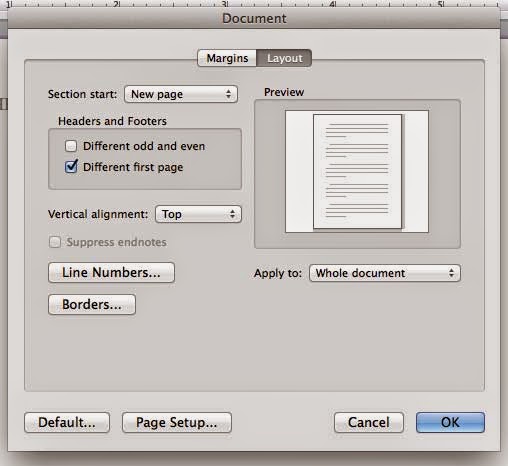
Only the cover page needs the caps lock RUNNING HEAD. All the other pages in the essay will have the short version of the title (but now it's in ALL CAPS). So you are going to have to insert the header one more time, but before you do that, you need to make sure one thing is set in the document. The formatting of the document needs to be set to have a different first page (the cover page). To do this, access the DOCUMENT formatting window. It's pretty simple. Under the FORMAT menu, select DOCUMENT, and the DOCUMENT window will open. Click on LAYOUT and the the check box on "Different first page." Now the second page in the document will have no header, so you can go to the second page, use the VIEW menu to view the editing screen for the header and footer, and then type in the running head in all caps.


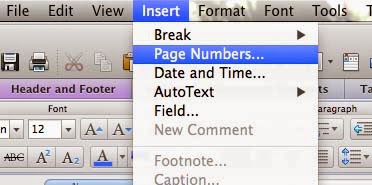
But now you need to also insert the page numbers. The headers are conveniently set up with pre-set tabs. As an aside, you should never move characters over by using a bunch of spaces. If you hit repeated spaces to move the page numbers to the right, then the location of the page numbers will be inconsistent depending on the computer of the person viewing the document. In some cases, the page numbers might even jump to a second line on the left. Always use the tab key (on the left side of the keyboard, just above the caps lock key) to move things. And take the time to learn how to set tabs. Depending on how long your running head is, when you hit the tab key, the cursor will jump to the middle of the page, or to the right hand side. If it goes to the middle, then do another tab to get the cursor to the right. Under the INSERT menu, choose PAGE NUMBERS to call up the page number dialogue box. Make sure you have alignment right and show on first page checked, and click OK. You can change the format to Roman numerals, etc, but probably the default is correct. If you have multiple sections on a thesis, then you need to use different formats and start the regular numbers on the first page of the actual content. Now, all you have to do is click the "Close" box on the little line under the header, and every page in your document will be properly formatted with APA headers.

Tuesday, 26 November 2013

How to cite a webpage in APA style

There seems to be some controversy over how to cite a web page using APA style. When a student finds information on a website, he or she often uses the title of the article as the reference. For example, citing this page he or she would use ("How to cite a web page", 2013). This is wrong, because there is clearly an author for this blog post: Peter J. Francis. You should cite the name of the author, just like you would a journal article. Be thorough; look carefully in the fine print for an author.

Just today I edited an essay that cited three newspapers. I know that virtually every story in a newspaper has a byline. I used to write for newspapers and seeing my name in print was half the reward. There is absolutely no reason not to know the name of the author of a newspaper article. Normally, when I am editing, I correct these things, but this person had not provided the full url in the reference section (which I pointed out when I returned the paper).

However, often a webpage is written by the member of a staff of an organization. Let's say HyperGraphix was a big anonymous editing company and there was no author on the page. Would you cite it as ("How to cite a webpage in APA style", 2013) or (HyperGraphix, 2013)?

I've researched this a lot and the answer is contradictory. Sometimes you use the name of the organization, sometimes you use the title of the article. I will try to tease out what the difference is.

There are four elements necessary for a complete citation: author, date, title, and url. Format is added if the format is out of the ordinary, such as a blog post, or lecture notes. One or more of these may be missing. This link tells you to use the title when you have no author.
http://blog.apastyle.org/files/how-to-cite-something-you-found-on-a-website-in-apa-style---table-1.pdf

However, this link says to use the organization as author when you have no author named. http://www.apastyle.org/learn/faqs/web-page-no-author.aspx

Normally I use the OWL (Purdue University Online Writing Lab) as my goto source for APA references. https://owl.english.purdue.edu/owl/resource/560/01/ This easy to use resource has lots of examples for all APA questions. There is also an MLA section, and I recently discovered a Chicago section. Many universities have APA or other style references, but I find this one to be the most comprehensive. But the OWL is strangely silent on the web page with no author. Maybe they don't give a hoot!

The two links above are both from the APA, so which is right? I had a client marked down because she used a title where an organization should have been used. I think the question is whether the organization is a professional organization, or is it just a place that posts information. For example, my client was doing a Master's degree in Nursing and was citing a document from the Centers for Disease Control. So this is a document that has been prepared for and by an organziation (CDC, 2013). Cite the organization.

On the other hand, if you were citing Travelocity's tips for vaccination, then Travelocity is merely posting information it has obtained elsewhere. Cite the webpage title ("Get stuck for health", 2013). Notice the webpage title used double quotation marks. You can use an abbreviated version of the title.

This makes some kind of sense because you can trust a named author more than an organization and an organization more than some webpage. There's a hierarchy of trust.

Back to my original question. Would you cite it as ("How to cite a webpage in APA style", 2013) or (HyperGraphix, 2013)? I would like to think you would use the latter. HyperGraphix is my editing business, and I should have some expertise. In addition, this website is the sole property of my editing business, and it's not designed to let other people post. You can be certain that HyperGraphix is responsible for the content. So give me the credibility of using my business name.

The next problem is how to set up the reference in the reference section. Do not use quotation marks on the title in the reference section. The first part of the entry should be the same as the in-text reference. As I explain to my students, the system is designed so you give a brief in-text reference, and if the reader wants more information, he or she should be able to find the full information in the reference section. That's why the reference section is in alphabetical order, and each entry begins with the same words used in the citation.So for the reference entry to this web page, write it like this:

Francis, P.J. (2013). How to cite a webpage in APA style.  [weblog]. Retrieved from http://essaywritngtips.blogspot.ca/2013/11/how-to-cite-webpage-in-apa-style.html

If there was no author, then it would be:

How to cite a webpage in APA style. (2013). [weblog]. Retrieved from http://essaywritngtips.blogspot.ca/2013/11/how-to-cite-webpage-in-apa-style.html
Updated April 2, 2014.

Thursday, 17 May 2012

10 Ways to Improve Essay Marks


Looking at the many essays that I edit for students, it's sad to see how many students are going to lose marks that they could have easily earned. So I put together this list to help students improve essay marks. You may notice that this list does not include hiring a professional editor. The main part of your grade should be about your thinking. Nonetheless, there are a lot of basic steps to take to improve essay marks. These are things that you should be focusing on yourself to improve your writing, and therefore, grades.

How to Improve Essay Marks

10. Use the correct format.

English essays use MLA style; a lot of other subjects use APA format, but don’t assume. There are dozens of styles, and some are particular to certain institutions. Your school may have its own style. If your professor hasn’t specified, ask. Or, you can use Google, and search for your subject, plus the words “citation style.” Each style has specific ways to cite, and although it's easy to get confused. Here's a link to a page with a list of styles. Here's a comparison between APA, MLA, and Chicago styles.

9. Make a title page.

APA and some other major styles require a title page with the name of the essay, your name, the course name, your professor’s name, and the date on it. Not only does this make the essay look tidier, your professor will know who wrote it, and you will get credit where credit is due. Use the “Insert Break--Page Break” command after the title page (see below “Use the tools in your word processor). Here's an APA sample paper. (MLA only requires you to put your name, course number and professor's name at the top of the first page.)

8. Use the tools in your word processor.

Word processors are designed to make writing easier. And they work! You can turn on and off the spelling and grammar under the Tools menu. Make sure they are turned on, or if they annoy you while you are writing, turn them on after you finish. If you are using MS Word and a red line appears under a word, then it’s misspelled. Fix it! If a green line appears, then Word is questioning your grammar. It also highlights extra spaces between words and little things that just make the essay look messy. I know that Word can be wrong, but you need to think carefully before moving on. If English is not your native language, and you write in another language in your word processor, check that the document is in English (Language, also under the tools menu). You can use the Paragraph formatting (under Format) to specify “Indent first line” for body text, “Hanging” for references, and “Keep lines together” when a heading appears at the bottom of a page away from the following text. Use “Insert--Break--Page Break” when you want to force a page break instead of a bunch of returns. When you edit, you won’t need to be continually adjusting where the page breaks. Only single space between sentences. The word processor will visually adjust the space.  I wrote a whole blog post on 5 Essential MS Word Tools Every Student Should Know.

7. Double space.

Most styles require double spacing. Even if you are submitting the essay to an editor who charges by the page, they will charge you for more pages. Somewhere on the site, they have something like "275 words equals one page." In addition, double spacing makes the paper so much easier to read. Even if you are writing an essay with no defined style, such as a personal reflection, double space. Your professor or marker will appreciate it and that’s the person who should be happy at the end of reading the essay.

6. Make sure each paragraph is related to the assigned topic.

It’s easy to go off on a tangent. The purpose of an essay is to discuss a particular topic, not show off the breadth of your knowledge. In a thesis, you may need to discuss the methodology and background, but in most undergraduate essays, just discuss the topic. It's important to keep this in mind when writing, but also you should think about it when editing. Revising for a second and third draft shouldn't be all about grammar and wording, but also about whether or not you have honed your ideas to make a logical point.

5. Ensure each paragraph has a topic sentence and all sentences are relevant to the topic sentence.

It’s easy to jump into a paragraph with a quote or idea that you believe is important. But when you review the essay, think about each paragraph as an individual unit. The key idea should be clearly set out. In fact, you should be able to summarize your essay by choosing one sentence from each paragraph. Make sure you have explicitly stated that idea in each paragraph. When an essay does not have a clear thesis statement, one result is that paragraphs might contain irrelevant information. Here's some information about paragraphs.

4. Make sure your introduction has a clear thesis statement.

A good introduction will orient the reader to the topic, provide some general information, and make a clear thesis statement. It is not necessary to say, “It is the purpose of this essay to discuss…” but certainly make a clear statement that you intend to prove through the body of the essay. Here's more about the thesis statement. I recently learned that many students coming to a university in Canada and the U.S. from Asian countries have been taught a different approach to defining their essay objective. These students provide a lot of information throughout the essay and bring it together in their conclusion. The standard way when writing in English is to prepare the reader by stating your objective in the introduction. Maybe we English speakers are not as bright as Asian thinkers, but as one person told me the format of the essay is: This is what I'm going to tell you (introduction), this is what I'm telling you (body), and this is what I told you (conclusion).

3. Include a quote, citation, or fact in each paragraph and explain its importance.

Especially in high school and first-year university essays, students ask, “how many citations do I need?” That’s like telling the teacher you only want a C. Learning to properly use citations is one of the keys to developing your academic writing skills. Don’t confuse citations with sources. You might use only one or two sources (books, articles, etc.) in your essay research, but each separate idea from those sources needs to be cited. Each paragraph (with the possible exception of the introduction and conclusion) should cite some authority so the arguments that you are developing in that paragraph carry some weight.

2. Summarize, but don’t repeat in your conclusion.

Your conclusion could remind the reader of some of the major points or it could make a recommendation based on the thesis statement. A lot depends on the topic and the format of the essay. However, every essay needs to have some kind of summation, so the reader is not left hanging at the end. People often ask me if it is necessary to use quotes or references in a conclusion. The answer is that it's not. You shouldn't be introducing new facts or observations in a conclusion. Therefore any information you present has already been presented in your essay and sources cited. The exception is if you want to end with a quote. Just like in an essay, using a pithy quote from a well-known thinker is a good way to come to a completion. Here's more about writing a great conclusion.

1. Make an outline first, and then follow it.

I can’t emphasize this enough. Essays that are written without outlines tend to be disorganized. The logic doesn’t flow. There are often bits that don’t relate to the theme, or ideas that are repeated. It’s a mess. This has to be the number one reason people write poor essays. Here's some information about creating an outline. The most important part of your essay mark is the content of your essay. An essay is a demonstration of your thinking about a topic. Try to say something interesting and justify it with evidence from the text or other sources.

Updated March 8, 2018.
Image courtesy of Salvatore Vuono / FreeDigitalPhotos.net

Wednesday, 16 May 2012

How to use APA Style

This is only a brief overview of some of the issues of using APA style in your text references based on some of the problems I've seen in the essays I've edited. If you want to source the details of APA style, go to the source: The American Psychological Association.

In-text citations 

Basically, the difference between APA style and the other major style of citations, MLA, is how APA uses in-line text citations. In APA style, the name of the author and the year of publication are inserted in brackets directly after the reference (Francis, 2010).

The first challenge for using APA style for in-text citations is when to use page numbers. "If you are quoting from a text, then you should use page numbers" (Francis, 2010, p 3.). If you are only paraphrasing an idea, then only use the author's name and date of publication (Francis, 2010). If a work has two authors use both names joined by "and" in the text and both names joined by & in the parentheses (Francis & Francis, 2010). With three to five authors, cite all names in the first instance and use "et al." in subsequent instances. Six or more, simply use et al. For an unknown author, cite the name of the work (HGPublishing, 2010).

It is important to note that et al. is an abbreviation and ends in a period. Do not put a period after a comma. If you have two sources for the same information, cite both in the same order as in the bibliography. (Francis, 2010; HGPublishing, 2001)

References

At the end of your essay, write a list of references. This is a list of all the references you have used, in alphabetical order by the last name of the main author. If there is not author's name available, use the title of the article, but place it alphabetically in the list as if it were the author's name. The reference list should be a separate page.

The basic format of bibliographical references for journal articles is:
Name, Initial., Name2, Initial., and Name3, Initial. (Year) Article Name. Journal Name. Volume number(issue number), pages.

Note the use of italics above. Only the Journal Name and Volume number are in italics. Each name is identified by the last name followed by the intial(s). Even if the journal identifies the authors by first name and middle name, you only use initials in APA style.

The biggest controversy I hear from students is how to cite sources from the internet. I often see students who include the date and URL for every reference which they downloaded. What the APA says is this:
"When a citation includes a digital object identifier (DOI) no further information is needed. When a DOI is not available, and a URL is included, do not include retrieval dates unless the source changes over time." A DOI is a special number used to identify an electronically published article. It is usually found on the first page of the article near the copyright notice or on the landing page where the article was found.

This means you do not need dates when you download articles from your library's electronic journal database. Simply use the DOI. You only need dates and URLs when you download information from a wiki since that web page can change at any time. For a web page, try to see if there is a date (often in small print for copyright purposes at the foot of the page). If there is a date, use it in brackets after the title. If there is no date use "n.d." for "no date." The reference for this page would be:
HyperGraphix Publishing Services (n.d.) How to Use AP Style. Retrieved from http://essaywritngtips.blogspot.ca/2012/05/how-to-use-apa-style.html